

Description
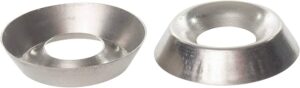
A plain washer is a thin plate, which is most commonly has a disk-shape with a hole in middle. It is widely used to distribute the load of a threaded fastener. Plain washers are used to provide a larger bearing surface where screws, bolts and nuts come in contact with the bearing surfaces.
The main role of flat washers is to increase the size of a screw’s bearing surface area, and reduce the surface pressure applied on the fastened object.
Looseness can result when the bearing surface sinks under the surface pressure, so using a flat washer to reduce the surface pressure is very effective.
This is especially crucial if the contact area between a screw’s bearing surface and the object being fastened is small when fastening to a slot, for instance, or if the object being fastened is made of soft material such as aluminum or resin.
Functions of Plain Washers
-
Load Distribution:
The primary role of a plain washer is to spread the load of the fastener over a larger surface area. This is especially important when dealing with softer materials such as aluminum, plastic, or wood, where the bolt or nut might otherwise press into the material and cause deformation or damage. -
Surface Protection:
Washers act as a buffer between the fastener and the material surface. This helps prevent surface damage like marring, scratching, or gouging when the fastener is tightened. -
Preventing Loosening:
Though plain washers are not specifically designed for locking, they do play a part in preventing fasteners from loosening by reducing friction between the nut or bolt and the surface. In combination with spring washers or lock washers, they can enhance joint security. -
Improved Torque Control:
Washers offer a smooth and even surface, helping to improve torque control when tightening fasteners. This can lead to more accurate clamping force and reduced risk of over-tightening. -
Compensating for Oversized Holes:
In some cases, the hole in the base material may be slightly larger than necessary. A plain washer can help to cover these gaps and still provide a proper load-bearing surface.
Applications of Plain Washers
Plain washers are used across virtually every industry that involves mechanical fastening:
-
Construction: For joining beams, metal frames, and structural assemblies.
-
Automotive: In engines, chassis components, and body panels to ensure secure joints.
-
Electrical and Electronics: To prevent grounding or short circuits using insulating washers.
-
Aerospace: Where high-strength, corrosion-resistant washers are required in high-performance applications.
-
Furniture and DIY Projects: Used in household assembly and repair tasks.


Reviews
There are no reviews yet.